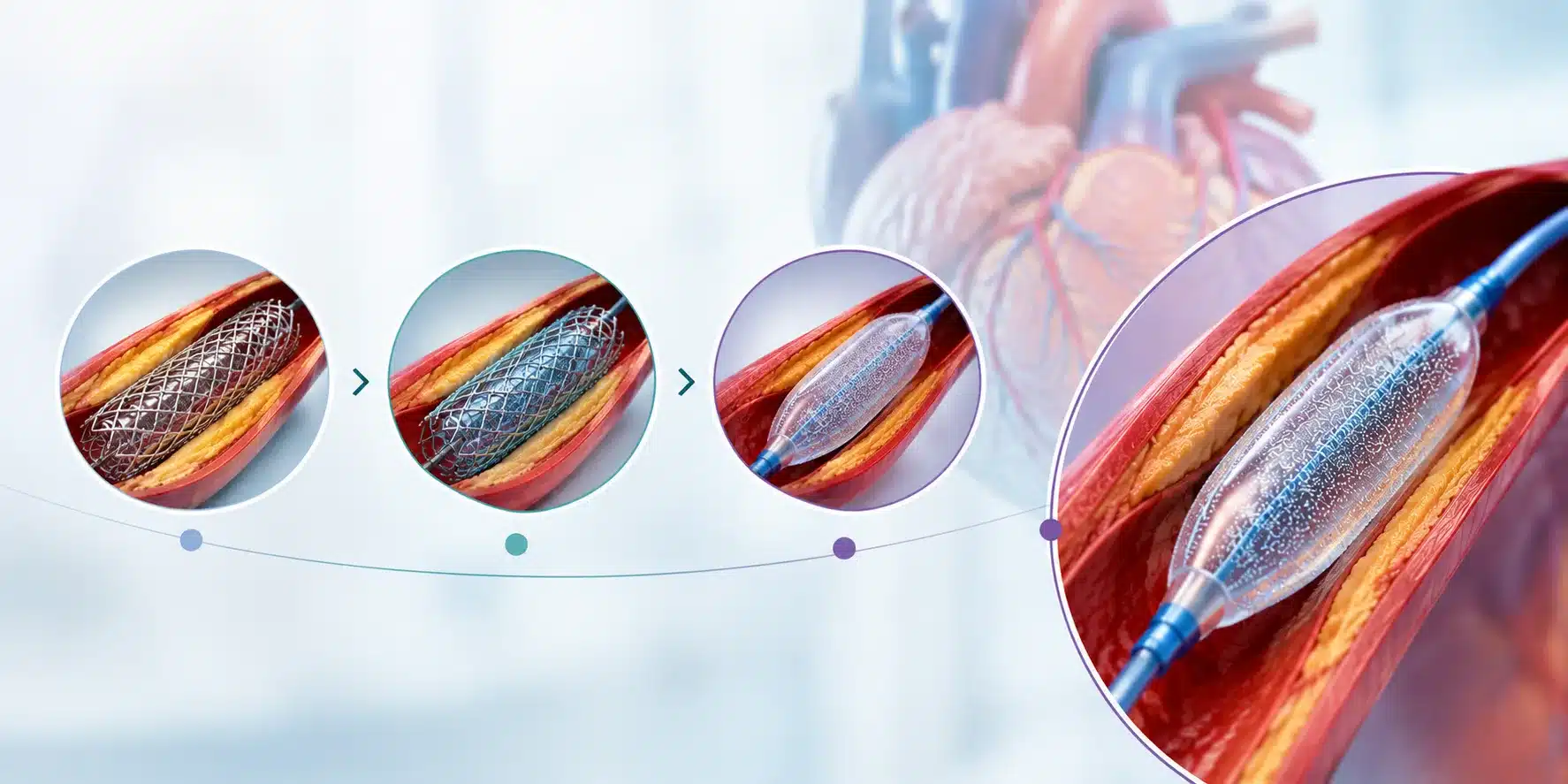

The treatment of coronary artery disease (CAD) has undergone remarkable transformation over the recent decades reflecting major advancements in interventional cardiology. The field has transitioned from highly invasive open-heart surgeries to minimally invasive procedures that improve safety, efficacy, and patient recovery. Advances in percutaneous coronary intervention (PCI), particularly with drug-eluting stents (DES) have significantly improved procedural outcomes and patient recovery. Although contemporary PCI has significantly reduced restenosis, ISR continues to represent an important clinical challenge.
Here is the closer look on how advanced technology such as drug-coated balloon angioplasty is reshaping the future of in-stent restenosis treatment and overall cardiac care.
Why in-stent restenosis remains a problem?
In-stent restenosis (ISR) is a complex biological process initiated by vascular injury with the persistent presence of the stent as a foreign body. Clinically, it may manifest as recurrent angina and can increase the risk of myocardial infarction or acute coronary syndromes often necessitating repeat revascularization procedures.
Restenosis occurs when the body’s healing response to vessel injury caused by stent implantation triggers smooth muscle cell proliferation and scar tissue formation within the treated artery. Although stent implantation particularly with drug-eluting stents (DES) has significantly reduced restenosis rates compared with bare-metal stents, a subset of patients continues to develop neointimal hyperplasia.
Managing in-stent restenosis remains challenging. Traditional treatment approaches, such as plain old balloon angioplasty (POBA), were frequently associated with high recurrence rates and the need for additional interventions. While repeat stenting can restore vessel patency, it creates multiple layers of metal within the artery a phenomenon often referred to as a “stent sandwich”—which may increase the risks of thrombosis, impaired vasomotion, and further restenosis.
Against this backdrop, drug-coated balloon (DCB) angioplasty has emerged as a promising treatment strategy. By delivering an antiproliferative drug directly to the vessel wall without leaving behind a permanent implant, DCBs offer an effective approach for treating ISR and are increasingly expanding their role in the broader management of coronary artery disease.
What is Drug-Coated Balloons?
Drug-Coated Balloons (DCBs) are semi-compliant transluminal angioplasty balloon coated with an antiproliferative agent such as paclitaxel, often combined with an excipient to facilitates rapid drug transfer into the vessel wall. Unlike traditional stents, DCBs deliver the drug directly to the vessel wall during brief inflation (typically 30-60 seconds) and are then removed, leaving nothing behind.
How DCBs work?
The technique of drug-coated balloon angioplasty delivers a therapeutic dose of drug during a single inflation (typically 30–60 seconds), inhibiting smooth muscle cell proliferation and reducing neointimal formation. Drug uptake occurs during balloon inflation and remains within the vessel wall after balloon removal. Crucially, DCBs do not leave a permanent implant, preserving the vessel anatomy and allowing easier future interventions when needed.
Why DCBs are the Ideal Choice for In-Stent Restenosis Treatment?
The rise of the drug-coated balloon in modern cardiology is backed by extensive clinical evidence. For patients and physicians alike, DCBs offer several distinct advantages and represent an effective, guideline-supported treatment option for in-stent restenosis (ISR).
- The “Leave Nothing Behind” Philosophy
The significant advantage of a DCB is that it delivers the medication without requiring a new permanent implant. By avoiding the placement of a second or third stent, cardiologists preserve the natural anatomy and flexibility of the artery. It prevents the dangerous buildup of metal layers, keeping future treatment options open if the patient requires further interventions down the line. - Targeted, Uniform Drug Delivery
Because a balloon conforms exactly to the shape of the blocked stent when inflated, enables relatively homogeneous drug delivery across the treated lesion. This ensures that the anti-proliferative drug is absorbed precisely where the hyperactive cell growth is occurring. - Shorter Duration of Blood Thinners
When a patient receives a new metal stent, they are typically required to undergo Dual Antiplatelet Therapy (DAPT)—taking two types of strong blood thinners—for a prolonged period (often 6 to 12 months) to prevent life-threatening blood clots. Because a DCB leaves no metal behind, the risk of late-stage blood clots is significantly lower. Consequently, patients treated with drug-coated balloon angioplasty can often safely reduce their time on heavy blood thinners, lowering their risk of bleeding complications. - Improved Healing
DCBs provide targeted drug delivery and are then removed, leaving nothing behind in the vessel. This enables the artery’s natural healing processes to take place, helping the endothelial lining recover without the added burden of another permanent implant
Evidence supporting DCBs in ISR
Evidence supporting DCBs in ISR
Multiple randomized trials and meta-analyses have compared drug-coated balloon angioplasty against repeat drug-eluting stent implantation or plain balloon angioplasty for in-stent restenosis treatment. Overall, DCBs have demonstrated comparable efficacy to repeat drug-eluting stent (DES) implantation in appropriately selected ISR lesions, while offering the advantage of avoiding additional stent layers. Notable studies include the PEARL Registry, which demonstrated the safety and efficacy of paclitaxel DCB in real-world ISR patients with low rates of target lesion revascularization; the AGENT IDE trial, which showed superiority of the Agent DCB over uncoated balloon in reducing target lesion failure; and other trials like ISAR-DESIRE 3 and RIBS IV that provide insights into long-term outcomes.
Clinical guidelines from the European Society of Cardiology (ESC) support the use of drug-coated balloon angioplasty for in-stent restenosis treatment, although recent 2024 updates recommend DES over DCB in certain DES-ISR cases while acknowledging DCB as a valuable option.
The Future of Restenosis Management
Drug-coated balloon angioplasty is shifting the paradigm in restenosis treatment and coronary artery disease treatment toward “leave nothing behind” or minimal implant strategies. As technology improves and evidence grows, DCBs could become a cornerstone for many PCI patients, reducing the lifetime burden of stents.
For patients battling recurrent ISR, this innovation offers renewed hope: effective symptom relief, lower re-intervention needs, and preserved vascular health.
Challenges and Considerations
Drug-coated balloons aren’t a cure-all. They work best after careful lesion preparation; if you get big dissections or recoil, you may still need a bailout stent. Availability and outcomes vary by center and operator skill. Patient and lesion selection are key—DCBs are ideal for small vessels, bifurcations, and recurrent ISR, but they don’t replace DES in all complex cases.
Ongoing trials continue to refine indications, including direct comparisons and expanded use in acute coronary syndromes or de novo disease.
Conclusion
Drug-coated balloon angioplasty offer patient friendly option in-stent restenosis treatment. By delivering antiproliferative medication directly to the vessel without implanting another stent, DCBs preserve arterial flexibility and avoid the problems of piling on metal. This “leave-nothing-behind” strategy is especially useful in small vessels, bifurcations, and patients where minimizing DAPT matters. When lesions are well prepared and operators are experienced,
DCBs provide durable results and simpler long-term care, and they’re an increasingly important tool alongside DES.
References
- In-stent restenosis pathophysiology and risk factors: a comprehensive review. Medicina (Kaunas). 2026;62(2):345. doi:10.3390/medicina62020345
- Recent advances in the treatment of coronary in-stent restenosis. J Clin Med. 2024;13(23):7123. doi:10.3390/jcm13237123
- Vlieger S, van der Sangen N, Oemraw R, et al. Clinical performance of a paclitaxel drug-coated balloon in real-world percutaneous coronary intervention practice: the PEARL registry. J Invasive Cardiol. 2022;34(10):E789-E795
- Yeh RW, Jaffer FA, Shlofmitz RA, et al. Paclitaxel-coated balloon vs uncoated balloon for coronary in-stent restenosis: the AGENT IDE randomized clinical trial. JAMA. 2024;331(12):1025-1034. doi:10.1001/jama.2024.1234
- Alfonso F, Macaya D, González-Ferreiro M, et al. Drug-coated balloon angioplasty for in-stent restenosis: pros and cons. EuroIntervention. 2025;21(3):e145-e156. doi:10.4244/EIJ-D-24-00567
- Byrne RA, Serruys PW, Kastrati A, et al. 2024 ESC guidelines for the management of chronic coronary syndromes. Eur Heart J. 2024;45(38):4153-4298. doi:10.1093/eurheartj/ehae456